

One Message, Every Touchpoint · Series 1 · Part 2 of 7
Here’s a question worth asking honestly: does your website, your social media, and your advertising actually work as one system — or are they three separate efforts that happen to share a logo?
Most churches aren’t taking advantage of some genuinely easy wins that would grow their reach without spending another dollar on ads.
Start with your sermons. If your sermons live only on Facebook or YouTube, they’re doing far less for you than you think. Search engines can’t fully index that content as yours — it’s living on someone else’s platform, optimized for someone else’s algorithm. A searchable sermon page, built right into your own website with the video player embedded, does far more for your visibility. Add sermon notes or small group discussion questions alongside the video, and you’ve turned a single Sunday message into a resource people actually search for and return to.
Then think about where people are actually searching. Google and Bing matter, but a growing number of people — especially the unchurched — are asking ChatGPT, Claude, and other AI tools their everyday questions and problems, or even asking what a church down the street is really like before they ever visit. If your content doesn’t live on a real, structured page on your own site, it’s largely invisible to those searches.
There’s also a distraction problem. When someone finishes your sermon on YouTube, what do they see next? An autoplay suggestion, an unrelated ad, a completely different creator’s video. The same happens on Facebook. You spent an hour crafting a message, and the platform spends the next ten seconds pulling that person somewhere else entirely — without you having any say in where. That doesn’t even touch the bigger question of what a platform like YouTube, Facebook, AWS, or Google might decide to do with your content if they ever disagree with your message.
And don’t forget your community events. If your seasonal highlight videos only ever show up once, the following Sunday, or buried in a year-end recap, you’re leaving one of your best pieces of content — real people, real moments, real community — sitting unused for the rest of the year, when it could be building your credibility with every new visitor to your site.
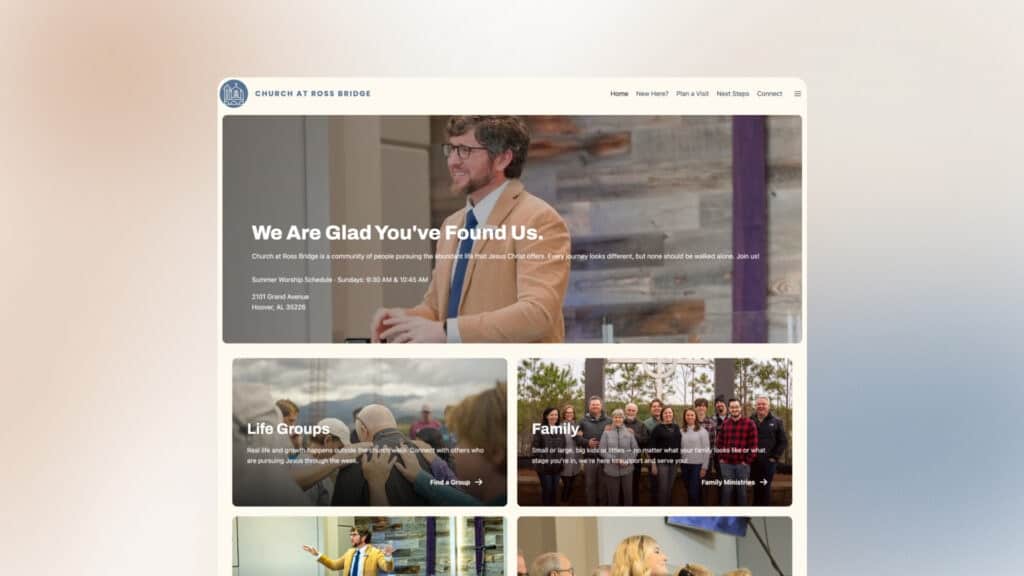
A website that actually works for you isn’t just a digital business card. It’s a growing, searchable, on-brand front door — one that keeps working long after Sunday is over.
(Curious what a church-built sermon and events system actually looks like? We’ll dig into that more in Series 2 — and True Engagement can help you build it.)
The takeaway: this is Engage. A digital footprint that works together meets people exactly where they’re already searching — one church, one story, before they’ve ever set foot on campus.
← Previous: Part 1 — The Series Overview — Why “Close Enough” Branding Isn’t Enough
Next: Part 3 — The First Four Minutes →
Explore all seven articles in One Message, Every Touchpoint →
Responses