

One Message, Every Touchpoint · Series 1 · Part 3 of 7
People form an opinion of your church long before they ever visit — from a friend’s mention, a social post, a website glance. But that opinion gets tested the moment they act on it: within about four minutes of turning onto your campus, and again within the first few minutes of walking through your doors. In that window, a guest is either reinforcing what they expected, or quietly deciding you’re not what you claimed to be.
This is where consistency stops being about design files and starts being about logistics.
Start with families. For a parent visiting with young kids, checking children into a classroom is one of the most anxiety-inducing parts of a first visit. The old-school approach — someone at a table hand-writing names on stickers, one for the child and one for pickup — is slow, error-prone, and puts real pressure on a volunteer trying to keep a growing line moving. It also quietly says this is a low-tech, low-security environment for something parents care deeply about.
Modern check-in technology changes that completely. A parent uses their own phone (or a simple kiosk) to register their child in seconds, generating a secure, matched pickup tag automatically. For a first-time family, this does more than save time — it signals the church has genuinely thought about child safety and about them specifically, rather than improvising on the fly.
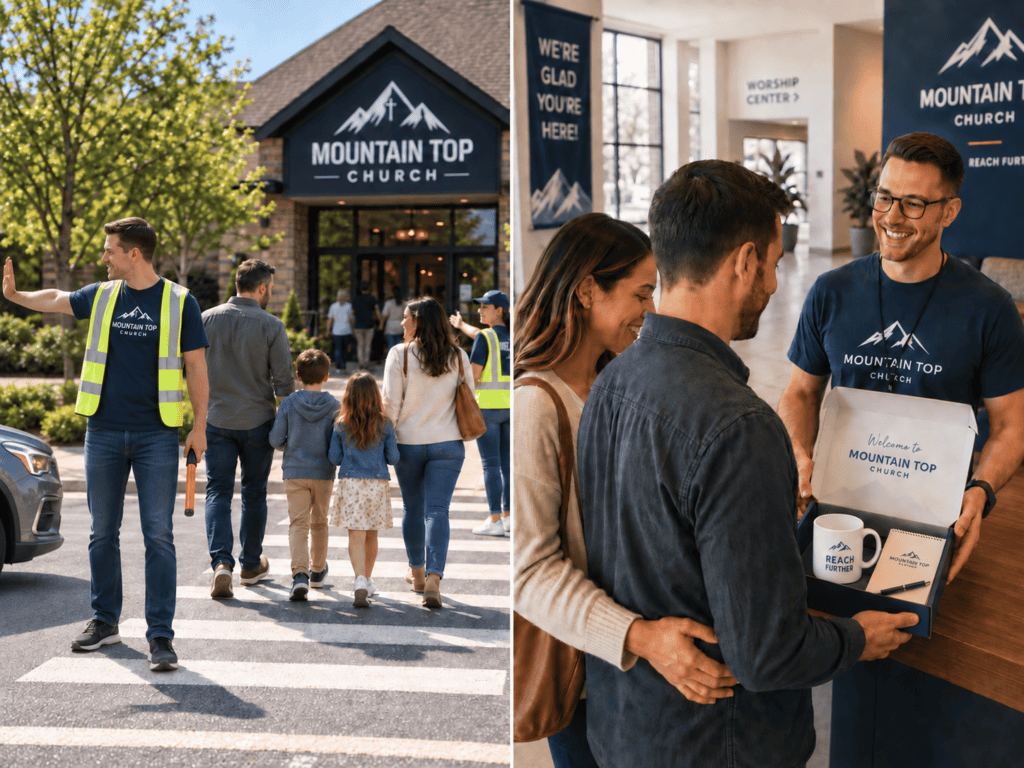
Then think about the adult walking in alone. A clear “Plan a Visit” pathway shouldn’t just give directions and service times — it should give a person. When someone knows, before they even arrive, that they can look for a specific greeter or guest services host by name, the anxiety of an unfamiliar building drops fast. Instead of wandering and hoping someone notices them, they have someone to look for.
Signage plays a supporting role here too — directional signs to check-in, kids’ areas, and guest services should visually echo what a guest already saw on the website the night before. When the physical space matches the digital one, it quietly confirms: you’re in the right place, and it was built with you in mind.
(In Part 4, we’ll walk through exactly what that “someone to ask” moment can look like — from the parking lot to the coffee bar. True Engagement helps churches design and run that whole experience.)
The takeaway: this is Engage, in person. The digital story from Part 2 has to keep being told, word for word, the moment someone steps out of their car — one church, one story, every touchpoint.
← Previous: Part 2 — Your Digital Footprint — Is It Working Together, or Working Against You?
Next: Part 4 — The Follow-Up Journey — Personal Touchpoints Done Right →
Explore all seven articles in One Message, Every Touchpoint →
Responses